
Snacks that are Healthy for Your Body and Your Braces

March 30th, 2022

You know the school day’s over when you hear these seven little words: “I’m home! Is there anything to eat?”

And before your child got braces, you had the answer: simple, tasty snacks that provided not only an energy boost, but nutritional elements to help build strong teeth and strong bodies. But now whole carrot sticks and unsliced apples are out. Nuts and crunchy peanut butter? Not in your pantry. Hard cheeses and crunchy whole grain crackers? Also off the shopping list.

Because any foods that are crunchy, chewy, or hard to bite into can damage brackets and wires, it’s time to freshen up your go-to snack list. Luckily, Dr. Elizabeth Hite, DMD, MS can recommend many healthy and braces-friendly choices when children need something to tide them over until dinner.

  • Fruits and Vegetables for Vitamins and Minerals

Soft fruits like berries, melon, and bananas provide essential vitamins and minerals while going easy on your child’s braces. Make it a blended smoothie for a cool treat—you can even add a healthy handful of spinach or kale without interfering with that fruity taste. If your child still loves apples and carrots best, keep them on hand—but remember that thin slices are the only way to go.

  • Dairy Delivers Calcium

Cottage cheese, string cheese, and other soft cheeses provide essential calcium and vitamin D. Yogurt in all its many flavors is another great option.

  • Meats Provides Protein

Lean meats such as thinly sliced ham, chicken, or turkey provide flavor and protein, and don’t require the chewing that bologna, roast beef, and salami do. And nothing packs a protein punch like eggs—hard boiled, deviled, or diced up in egg salad.

  • Grains, Legumes, and Vegetables for Complex Carbohydrates

Complex carbohydrates—the “good” carbs—are important sources of energy for our bodies. Snacks such as hummus with soft whole grain pita wedges or blended black bean dip and soft crackers are a delicious, energizing option.

You are constantly looking for ways to make your children’s lives better. Mix and match any of these foods for a snack that’s not only good for their braces, but good for their teeth and bodies! Let us know your child’s favorite snack the next time you visit our Edwardsville office!

Flossing Fact or Flossing Fiction?

March 23rd, 2022

Somewhere in a bathroom drawer or medicine cabinet, we all have one—that little plastic dental floss dispenser. And whether you use your floss every day (yay!), or have completely forgotten it was in there (not so good), just how much do you know about that sturdy string? Let’s find out!

  • Flossing has been around for hundreds of years.

FACT: It’s been just over two hundred years since Dr. Levi Spear Parmly, a dentist in New Orleans, suggested his patients use waxed silk thread to clean between their teeth. This is considered the first “official” invention of dental floss, although using some form of tool to get rid of food particles between the teeth has been around since prehistoric times.

  • Brushing well is the same as flossing.

FICTION: It’s really not. While brushing does a great job of cleaning food particles, plaque, and bacteria from your enamel, there are some places those bristles can’t… quite… reach. Floss was designed to clean plaque and food from between the teeth and close to the gum line where your brush doesn’t fit.

  • There’s more than one way to clean between your teeth.

FACT: Indeed there is! Not only are there many varieties of dental floss (waxed, flavored, round, flat, thick, thin, in a dispenser, attached to miniature floss wands), but you have alternatives if using any kind of floss is difficult for you. Water-flossers direct a pulsing stream of water between and around the teeth and gum line to remove food particles and plaque. Another useful alternative is the interproximal brush, a tiny little cone-shaped brush designed to remove food and plaque from those hard-to-reach spots.

  • It’s impossible to floss with braces.

FICTION: Untrue—but it can be more challenging! That’s why there are any number of flossing products designed to work with and around your braces. Stiff strands of floss which work like dental picks, floss threaders, water flossers, and interproximal/interdental brushes can both clean between your teeth and remove food particles and plaque where they collect around your braces. Dr. Elizabeth Hite, DMD, MS can suggest some great options to work with your individual orthodontic treatment.

  • Flossing helps prevent gum disease.

FACT: Scientific studies haven’t provided definitive answers. But dental and periodontal associations strongly recommend daily flossing as one of the most important things you can do to prevent gum disease. Gingivitis, or mild gum disease, is caused by irritated, inflamed gum tissue. Gum tissue becomes irritated and inflamed as a response to the bacteria, plaque, and tartar that stick to your teeth. Anything you can do to help remove these irritants will reduce your risk of gum disease.

  • Flossing helps prevent cavities.

FACT: Dentists strongly recommend daily flossing to remove the food particles and plaque that lead to cavities. Brushing removes cavity-causing plaque from the outer surfaces of your teeth. But there’s a lot of enamel between your teeth as well. Flossing removes plaque from these hidden spots, helping to prevent interproximal (“between the teeth”) cavities from forming.

  • Bleeding when you floss is normal.

FICTION: Bleeding isn’t a typical reaction to flossing. Bleeding gums could be an early sign of gum disease caused by plaque and tartar buildup. On the other hand, if you floss too hard, or go too deeply below the gum line, you can make delicate gum tissue bleed. Ask Dr. Elizabeth Hite, DMD, MS for tips on perfect flossing technique.

  • You need to floss after every meal.

FICTION: Dental professionals generally recommend brushing twice a day and flossing at least once each day. But this suggestion comes with some exceptions. Since you have braces, Dr. Elizabeth Hite, DMD, MS might recommend flossing whenever you have a meal or snack.

  • Your dentist will never know that you haven’t been flossing.

FICTION: Nope. Sure, you can miss flossing a few times and catch up before your appointment at our Edwardsville office. But built-up plaque between the teeth, red, swollen, or bleeding gums, and gingivitis and interproximal cavities let both you and your dentist know that you’ve been neglecting good dental habits.

  • It’s never too late to start flossing!

FACT: Flossing is a simple, quick, and inexpensive way to maintain tooth and gum health. If you haven’t had much luck flossing in the past, ask Dr. Elizabeth Hite, DMD, MS for flossing tools and techniques that will work for your specific needs. Start now, and see what a difference it will make at your next checkup!

If you had all these flossing facts at your fingertips, congratulations! But if you didn’t, no need to worry, because the real test of your knowledge is in its application. Flossing properly at least once each day will give you something far more rewarding than blog-quiz kudos—you’ll see that regular flossing rewarded with healthier teeth and gums!

St. Patrick's Day: Celtic pride, green shamrocks, and lucky charms!

March 16th, 2022

“St. Patrick's Day is an enchanted time -- a day to begin transforming winter's dreams into summer's magic.” Adrienne Cook

Lucky green shamrocks, leprechauns, and pots of gold – it must be St. Patrick’s Day! If you’re not Irish, how do you go about celebrating St. Patrick’s Day? It’s easy: You just put on one of those tall leprechauns hats, dress in green from head to toe, and wear one of those carefree pins that say “Kiss Me, I’m Irish”. On St. Patrick’s Day, everyone is Irish, and that is the universal beauty of the holiday. Celtic pride does not discriminate.

Wondering what our team at Bauer Hite Orthodontic Specialists is doing to celebrate March 17th? Well, we’ve thought about doing everything from handing out lucky gold coins (you know, the fake ones that are made of chocolate) to shamrock stickers. Maybe we’ll even give away green toothbrushes and floss! You’ll never know unless you come in to see Dr. Elizabeth Hite, DMD, MS !

All kidding aside, St. Patrick’s Day is an important cultural and religious holiday. There are lavish parades and church services across Ireland on March 17th. Over time, however, the holiday has developed into a day to observe Irish culture in general. In places like England and the United States, where there is a large Irish Diaspora, the holiday has greater significance than other countries. From the streets of Boston to St. Patrick’s Cathedral in New York, it is a day of celebration, and many Americans of Irish descent will cook up a traditional meal of corned beef and cabbage.

So, to all of you with Irish ancestry, and to all of you who have decided to be Irish for the day, our office wishes you a Happy St. Patrick’s Day. Good luck looking for a pot of leprechaun gold, which is said to exist at the end of the rainbow. However, keep away from those sugary Lucky Charms; sweet cereals might taste good, but your kids’ teeth might not be feeling too lucky if they eat it for breakfast every day. Have a great St. Paddy’s Day!

Color Combinations of Elastics for the Holidays

March 9th, 2022

There's something special about customizing the elastics on your braces to fit your unique personality. Once you embrace your braces (no pun intended) you'll realize how many color options and combinations there are to choose from. Although you'll have a fantastic smile afterward, you won't have this level of customizability once your braces come off, that's for sure!

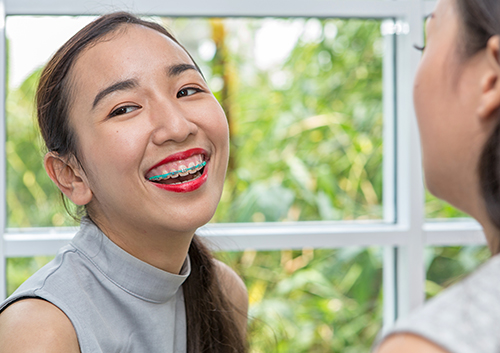
Adding flair to your braces isn't what all patients are looking to do (like those opting for clear aligners or ceramic braces), but it's part of the fun of traditional metal braces! Many of our patients ask Dr. Elizabeth Hite, DMD, MS to have their elastics match the colors of their favorite sports teams or their school, but how about changing your elastics to match holiday colors?

Here are some options to consider:

  • Valentine’s Day – Red and pink
  • Easter – Pink, blue, and violet
  • Halloween – Orange and black
  • Christmas – Red, green, and white
  • Saint Patrick’s Day – Green and white

There are a few colors that some people choose to avoid. But if you’re trying to make your teeth stand out in a crowd, the following suggestions need not apply!

  • Brown or Green – can be mistaken for food being stuck in your teeth
  • Black – might look like a rotten tooth if someone isn't looking hard enough
  • White – Some patients think it will make their teeth look whiter, but in fact it can make your teeth appear yellower than they actually are. White elastics can also stain easily.
  • Yellow – accentuates the yellowness of your enamel

Since changing the color of your elastics has no effect on the actual orthodontic treatment process, the idea is to have fun and add a personal touch. So, next time you get your elastics changed at our Edwardsville office, why not wear your braces boldly and opt for something festive?

Back to Top
Contact Us!
call email