
How Long Will I Wear My Braces?

April 27th, 2022

How long? Well, a beautiful smile is both science and art—proper teeth and jaw alignment united with aesthetically pleasing results. Orthodontists achieve both these outcomes with a careful analysis of any dental and facial problems, a treatment plan designed specifically for each patient’s needs, and adjustments through each phase of treatment to carefully bring about that beautiful smile.

And that’s a long way of saying, there’s no one, standard answer as to how long a patient will wear braces because there is no one, standard patient. Often, treatment takes from 18 to 24 months, but it can be months shorter or months longer depending on a variety of different circumstances.

  • Different Needs

Your orthodontic needs and goals will generally determine your treatment time. Some patients need only a bit of alignment, which can lead to a fairly short orthodontic experience. Some have malocclusions such as crossbites and open bites that require more complex and lengthy treatment.

And, while we used to think of orthodontics as a teenage rite of passage, that’s certainly no longer the case. Some children will need two-phase orthodontic treatment, where early procedures before the adult teeth even come in ease the way for any necessary second stage treatment when the permanent teeth arrive years later. And some adults will want orthodontic work later in life, where denser bone tissue might lead to (somewhat) longer treatment.

  • Different Appliances

Today’s orthodontics offers you many choices in appliances. Lingual braces are an almost invisible option, with brackets and wires on the inside of the teeth. Aligners use clear, custom molded trays to move the teeth into a better position with each new tray. Even traditional braces are smaller and sleeker today, with metal or less visible ceramic brackets. Depending on the orthodontic goals you want to achieve, there might be a small difference in the amount of time each appliance will take to get you to those goals. Talk to us about all your options and what they mean for treatment time.

  • Different Levels of Participation in the Process

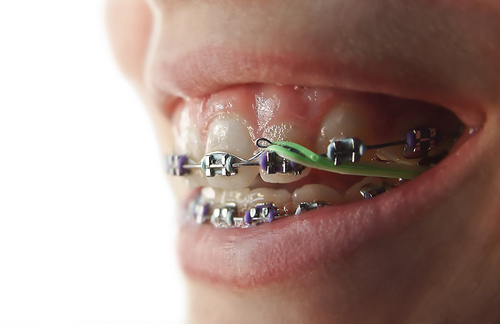
This is one area you can make a real difference! If you follow our instructions for using your appliances most effectively, you’ll make progress as quickly as possible. If you have aligner trays, be sure to wear them for as long as directed each day. If you have rubber bands attached to brackets on your upper and lower teeth, wear them for as many hours as required, because these little bands are actually the tools that are moving your teeth into alignment. If you don’t wear your braces or aligners as directed, not much is going to happen, and certainly not on schedule.

Give our Edwardsville office a call, and we can discuss your goals for creating your very best smile. Once we’ve decided on a treatment plan, Dr. Elizabeth Hite, DMD, MS can give you a fairly good estimate as to how long your particular treatment will take. And, when you get to share that beautiful, healthy smile, the time you’ve spent achieving it will be well worth it!


Worst Candy for Braces

April 20th, 2022

Most kids love candy; actually, most people in general love candy. So when it comes time for you to get braces there can often be a natural conflict between candy consumption and maintaining the integrity of your braces. For that reason, Dr. Elizabeth Hite, DMD, MS and our team know that it’s good to know which types of candy are not good for your braces. To better illustrate, here are some candies that you will want to avoid.

Caramel

Caramel is a sweet and often exceedingly sticky and chewy type of candy that just does not mix well with braces. Caramel can cause a mess in regular teeth, but teeth with braces are a whole other story. The sticky candy can very easily get lodged and stuck between the teeth, gums, and braces, making for a difficult task of cleaning your mouth. And if your teeth don't get cleaned properly, cavities can easily form. If you get cavities while you have braces, that could mean additional appointments at our Edwardsville office and an extended treatment time.

Salt Water Taffy

Another sticky and chewy candy to avoid with braces is salt water taffy. For many of the same reasons as caramel, it is best to avoid taffy until you get your braces removed. It may be a long wait, but when it comes to the health of your teeth, and the purpose of your braces, it really is best to avoid taffy.

Popcorn

Popcorn of any kind is best to avoid when you have braces. The kernels can easily do damage to the braces as you chomp on them, and they can get stuck between your teeth and the braces causing discomfort and further complications. In this sense it does not matter which flavor of candy popcorn you eat, all popcorn is bad news until you get your braces off.

Generally speaking, any candy that is chewy, crunchy, or sticky is not a good idea to eat with braces in your mouth. These types of candy will make life wearing braces much more difficult than if you were to just wait until your braces come off. With a little patience you will be back to eating all your favorite candy again, and with straightened teeth at that.

Orthodontics: From Tooth Fairy to Retainer

April 13th, 2022

You might be surprised to learn that Dr. Elizabeth Hite, DMD, MS and our team recommend an orthodontic appointment even before your child has had that last visit from the Tooth Fairy. In fact, orthodontic assessments at our Edwardsville office can be beneficial at many stages of your child’s life. Let’s look at some of the reasons why.

The Right Spaces

There’s a reason why we recommend that every child see an orthodontist by the age of seven. If there’s room enough in your child’s mouth to accommodate all the permanent teeth that will be arriving soon, you’re good to go. But if it looks like there won’t be enough space for those adult teeth, there are solutions we can offer to make the transition from baby teeth to adult teeth a smoother one.

  • If your child’s mouth is small, the permanent teeth might have too little room to fit in when they arrive. We may recommend gently enlarging the upper dental arch with the use of a palatal expander. This device will provide room for the adult teeth, and could potentially shorten second phase treatment time.
  • Too much space can also be a problem. If a child loses a baby tooth too soon, too much space between the remaining teeth can cause them to shift out of position, leaving the wrong spot open for the adult tooth to come in. We might recommend a space maintainer so that there is no shifting of the teeth, and there is room for the adult tooth to erupt in its proper spot.
  • If there is a bite problem, early treatment can prevent more serious problems down the road.

If no treatment is necessary immediately, we can monitor the development of your child’s teeth and bite during periodic visits.

(Stay in) The Right Places

Once your child has achieved that perfect smile, it’s time to maintain it. Teeth actually move and shift throughout our lives, whether we have had orthodontic treatment or not. But with orthodontic treatment, the bone tissue and ligaments around the teeth remodel over time to hold the teeth in their new and improved positions. That’s why it’s often important to wear a retainer constantly for several months after the braces come off, as bone and ligament become a firm, strong anchor for the newly aligned teeth and bite.

But there’s no one expiration date on retainers! Worn nightly as needed, they help teeth stay securely in their new positions for a lifetime of beautiful smiles.

Healthy Smiles Mean Happy Faces

If you think your child is ready for any phase of orthodontic work, give us a call. We will be happy to make sure there is ample room for permanent teeth to erupt in their proper spots even during the baby teeth years. If braces are indicated at a later date, we will analyze any potential alignment and bite problems and present all of your treatment options. Finally, after the orthodontic work is completed, we want to make sure your child knows the best way to maintain that beautiful smile with conscientious retainer wear.

If you have any concerns about your child’s teeth or bite, even before the permanent teeth arrive, give our Edwardsville office a call. Early treatment can often prevent future problems and might even lead to faster orthodontic results. At each stage of your child’s growth, we are here to provide your best options for healthy, happy smiles.

Play it Safe this Spring

April 6th, 2022

It's springtime and it's again time to remind our patients at Bauer Hite Orthodontic Specialists to protect their faces and pearly whites while out on the field playing sports. According to the National Youth Sports Safety Foundation, children, high-school athletes and adults have more than 5,000,000 teeth knocked out in sporting events annually.

If you are planning on participating in spring sports, it’s imperative to have a proper-fitting mouthguard. Mouthguards can prevent chipped or broken teeth, lip and cheek injuries, jaw fractures, mouth lacerations and even concussions.

Having a mouthguard can make the difference between losing your teeth or not, and because many of our patients who play high school sports have jaws that are still growing, last year’s mouthguard may no longer fit as it should. Dr. Elizabeth Hite, DMD, MS and our team at Bauer Hite Orthodontic Specialists can fit you for a new guard.

To learn more about mouthguards or for general questions about your treatment at our Edwardsville office, please give us a call!

Back to Top
Contact Us!
call email